
Next Harbour is advancing its solar energy activities by leveraging established expertise in engineering, project development, project management, operational planning and commercial evaluation.
Our approach integrates technical, commercial and operational considerations to support solar projects throughout their lifecycle, from initial feasibility and concept development through engineering, delivery and long-term asset performance.
Our developing solar capabilities encompass:
Engineering & Project Delivery
Technology & Digital Innovation
Sustainability & Supply Chain
Through an integrated approach and strategic industry collaboration, we aim to advance practical, innovative and commercially viable solar energy solutions.
Practical steel canopies for farms and businesses
Next Harbour has worked with local farmers and commercial operators in Western Australia on small- and medium-scale steel canopy and car-parking projects. Our approach combines practical engineering with an understanding of site access, construction constraints and long-term operating needs.
Adaptable framing can provide vehicle shelter and create opportunities for solar integration, subject to project-specific design and approvals. Each solution is considered in the context of the site – not as a fixed template.
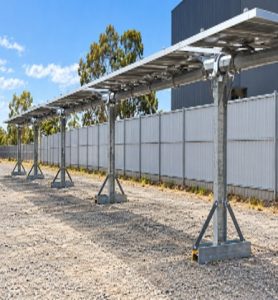
FRAME VISUALISATION BASED ON SUPPLIED PHOTOGRAPHS
Experience across agricultural and commercial settings
Built for real sites
For farming properties, projects may need to accommodate machinery clearance, working-yard access, exposure to wind and practical installation logistics. For commercial car parks, the emphasis includes vehicle movement, parking-bay geometry, pedestrian safety, drainage and integration with existing facilities.
Structural considerations
The supplied frame photographs illustrate galvanised steel columns, overhead supporting members, diagonal bracing and bolted connections. Modular arrangements can be adapted to the required layout, loading and ground conditions, with final sections and connections verified by detailed engineering design.
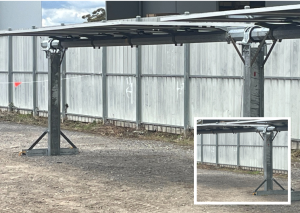
Example steel canopy frame and support assembly
Foundation and anchoring suited to the ground
Engineering the load path into the soil
An effective canopy foundation starts with a geotechnical understanding of the site. Soil strength and stiffness, groundwater, corrosion exposure and potential ground movement influence how the steel frame is supported. Wind uplift, horizontal forces and overturning must pass safely through the columns, braces, base connections and anchors into the ground.
The image below shows the above-ground braced steel base; any buried footing or anchor is not visible.
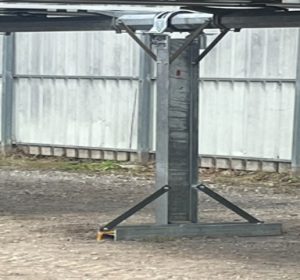
01 Sand and gravel Where bearing and uplift allow, consider engineered pad footings or ground screws, subject to ground investigation and testing. | 02 Soft or loose soils Bored or screw piles may be considered to engage deeper competent strata; check settlement and lateral resistance. | 03 Reactive clay or fill Piers or piled arrangements can be evaluated for differential movement, moisture change and variable support. | 04 Shallow rock Rock sockets or drilled anchors may be evaluated where rock quality and pull-out resistance are verified. |
Exploring solar-panel manufacturing
Next Harbour is exploring an expansion into solar-panel manufacturing, complementing its solar structural and project-engineering interests. This investment approach will assess viable product technologies, manufacturing and assembly methods, quality systems and Australian supply-chain pathways.
We welcome collaboration with industry, universities, research organisations and technology partners on manufacturing feasibility, materials and process innovation, prototypes, performance testing, certification and integrated solar-canopy demonstrations.
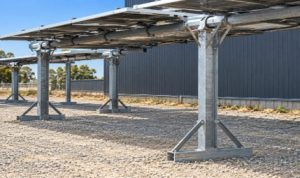
ILLUSTRATIVE SOLAR CANOPY VISUALISATIONS